
How Collagen Stimulation Is Redefining Modern Facial Rejuvenation
By Dr. Kambiz Boreshnavard, MD, PhD
Facial aging is no longer understood as a simple matter of wrinkles or volume loss. In modern aesthetic medicine, it is recognized as a complex biological process involving progressive changes in collagen integrity, tissue support, fat distribution, and bone remodeling.
Among all these factors, collagen depletion remains one of the most critical drivers of visible aging.
Collagen forms the structural foundation of youthful skin. It provides firmness, elasticity, and resilience, supporting both the surface and deeper layers of facial anatomy. Beginning in early adulthood, natural collagen production gradually declines, leading to thinning skin, reduced elasticity, loss of definition, and the gradual descent of facial structures.
For many years, aesthetic treatments focused primarily on replacing what was lost. Traditional dermal fillers became the dominant approach, offering immediate volume restoration and contour correction. While effective in specific indications, this method primarily addresses the symptoms of aging rather than the underlying biological process.
Over the past decade, a more advanced paradigm has emerged: collagen stimulation and regenerative aesthetics.
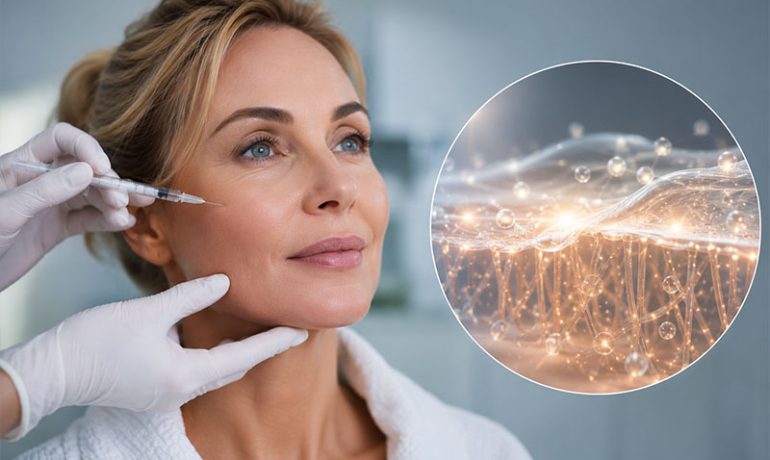
Instead of temporarily replacing volume, collagen-stimulating treatments activate fibroblasts—the cells responsible for producing new collagen. This allows the body to gradually rebuild its own structural support system from within.
In clinical practice, this represents a fundamental shift in how we approach facial rejuvenation.
Rather than focusing on isolated wrinkles or individual folds, collagen restoration allows us to address the overall architecture of the face. When the collagen network is strengthened, improvements are seen not only in volume, but also in skin quality, firmness, elasticity, and global facial harmony.
One of the most important advantages of this approach is the nature of the results. Collagen stimulation produces gradual, biologically driven changes. This progressive transformation often leads to outcomes that appear natural and undetectable as “treatment,” which aligns with the growing patient preference for subtle, authentic rejuvenation.
From my clinical experience, the most successful long-term aesthetic outcomes are achieved when treatment strategies are designed to restore structure rather than simply fill space. Patients do not merely look “fuller”—they look healthier, more rested, and more structurally supported.
Collagen biostimulation also plays an important role in long-term facial maintenance. By reinforcing the underlying dermal framework, these treatments may contribute to sustained improvements in tissue quality and help delay further visible signs of aging when incorporated into a structured aesthetic plan.
Among the available technologies in this category, Poly-L-Lactic Acid (PLLA)-based treatments such as Sculptra® represent one of the most established and scientifically supported methods of collagen stimulation. These treatments work by initiating a controlled regenerative response, leading to the gradual production of new collagen over time.
At Fantazia Aesthetics, collagen restoration is not considered an isolated treatment—it is a core philosophy of facial rejuvenation. Each patient is evaluated based on structural aging patterns, not just surface-level concerns, allowing for customized treatment strategies that prioritize natural balance, long-term results, and facial integrity.
The future of aesthetic medicine is clearly moving toward regenerative approaches that enhance the body’s own biological capacity rather than simply masking age-related changes.
Collagen stimulation represents one of the most significant advancements in this evolution.
It does not aim to change identity. It aims to restore structure, support natural beauty, and allow patients to age with confidence, refinement, and authenticity.
About Dr. Kambiz Boreshnavard
Dr. Kambiz Boreshnavard, MD, PhD, is the Founder and Medical Director of Fantazia Aesthetics and an internationally experienced physician with more than 26 years of expertise in medicine and aesthetic rejuvenation. He specializes in collagen restoration therapies, advanced facial rejuvenation, injectable aesthetics, and regenerative age-management strategies. He is a Faculty Member of the Canadian College of Aesthetic Dermatology and a Co-Founder of the Canadian Association of Cosmetic Dermatology and Surgery (CACDAS).
It’s a regenerative treatment that prompts your body to produce its own collagen, rebuilding facial support from within—unlike fillers, which simply add volume. PLLA stimulators like Sculptra® activate fibroblasts to gradually restore structure and skin quality.
Fillers replace volume immediately and fade as the product is metabolized. Collagen stimulators rebuild your natural collagen framework over time, addressing a root cause of aging rather than just filling lines. The two are often used together for best results.
Results appear gradually as new collagen forms, giving a subtle, natural-looking improvement. Because the collagen is your body’s own, results often last longer than many traditional filler treatments.
Patients with diffuse facial volume loss, age-related tissue thinning, hollow temples or cheeks, jawline changes, or generalized aging. It suits those seeking natural, long-term rejuvenation over dramatic change.
