
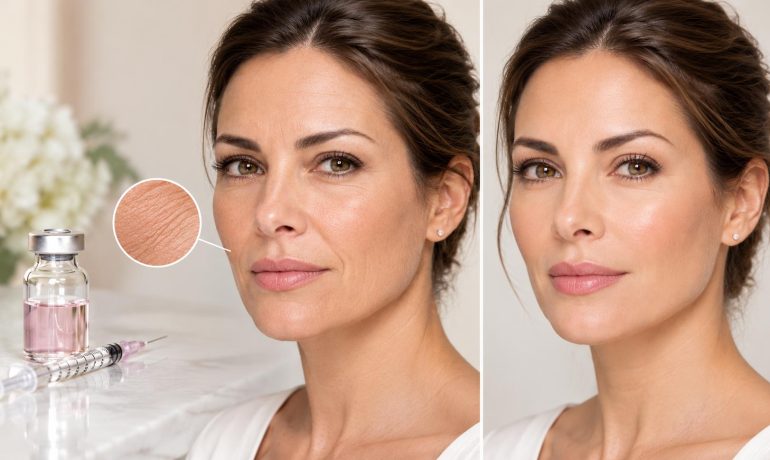
Sculptra is an injectable collagen stimulator designed to gradually improve facial volume, skin structure, and the appearance of certain age-related changes.
- Initial changes: Mild fullness may appear immediately after treatment because of the liquid used to prepare the product, but much of this temporary effect usually subsides over the following days.
- First few weeks: The immediate swelling generally settles, and the gradual collagen-building process begins to become more relevant.
- Around 1 to 3 months: Many patients begin to notice progressive improvements, although the timing and degree of change vary.
- Around 3 to 6 months: Results may become more apparent as collagen production continues following a treatment series.
- Treatment planning: Sculptra often requires multiple sessions rather than a single injection appointment.
- Longevity: Results can last up to approximately two years in some patients, depending on individual response, treatment plan, and other factors.
- Best next step: A professional consultation helps determine whether Sculptra is appropriate for your anatomy, goals, and medical history.
The most important thing to understand is that Sculptra works gradually. A realistic before-and-after comparison should reflect changes over time rather than only the appearance of the face immediately after an appointment.
Introduction: Why Sculptra Before and After Results Look Different Over Time
What if your facial rejuvenation treatment did not rely on creating an immediate change, but instead encouraged your skin to gradually rebuild some of the structural support it loses with age?
That is the principle behind Sculptra.
When people search for Sculptra before and after photos, they often expect to see a dramatic transformation immediately after treatment. However, Sculptra is different from traditional hyaluronic acid dermal fillers. Its primary purpose is to stimulate the body’s collagen production over time, which means the most meaningful changes may develop over several weeks and months.
Understanding this timeline is essential for setting realistic expectations and deciding whether the treatment fits your aesthetic goals.
This guide explores three essential areas:
- The results timeline: What may change immediately, after several weeks, and between three and six months.
- The factors behind your results: How collagen production, treatment planning, facial anatomy, and aftercare influence your outcome.
- The decision-making process: How to assess before-and-after photos, understand safety considerations, and determine whether Sculptra is suitable for you.
For individuals considering aesthetic treatments at Fantazia, understanding these differences can make a consultation more productive and help establish a realistic plan for natural-looking facial rejuvenation.
What Is Sculptra and How Does It Work?
Sculptra is an injectable biostimulatory treatment made with poly-L-lactic acid, commonly abbreviated as PLLA. It is used to stimulate collagen production, helping address certain forms of facial volume loss and age-related changes in skin support.
Collagen is a structural protein that contributes to the strength, firmness, and support of the skin. As people age, collagen production and the structure of the skin change. These processes can contribute to reduced facial fullness, deeper folds, and changes in facial contours.
Sculptra is designed to encourage a gradual biological response rather than simply placing a gel-like substance beneath the skin to create immediate volume.
How Sculptra Stimulates Collagen
After a qualified healthcare professional administers Sculptra, the poly-L-lactic acid particles trigger a controlled tissue response that stimulates collagen formation.
Over time, the body processes the material while newly produced collagen contributes to the treated area’s structural support.
The process generally involves several stages:
- The product is injected into appropriately selected treatment areas.
- The initial liquid component may create temporary fullness.
- That early fullness generally diminishes as the liquid is absorbed.
- The collagen-building response develops progressively.
- Changes in facial volume and contours may become more noticeable over subsequent months.
The rate of collagen production varies from person to person. Age, individual tissue characteristics, treatment technique, the number of sessions, and baseline facial volume can all influence the outcome.
Sculptra does not produce identical results for every patient, and collagen stimulation should not be confused with an immediate lifting procedure.
Sculptra Versus Traditional Dermal Fillers
Although Sculptra and traditional dermal fillers are both injectable aesthetic treatments, they serve different purposes.
Hyaluronic acid fillers provide volume by placing a gel beneath the skin. Depending on the product and treatment area, they can create a visible change shortly after injection.
Sculptra instead focuses on stimulating collagen production. Its effects develop progressively, making it more appropriate for patients who are comfortable waiting for gradual improvements.
| Feature | Sculptra | Hyaluronic Acid Fillers |
|---|---|---|
| Main mechanism | Stimulates collagen production | Adds volume through an injectable gel |
| Visible results | Develop gradually | Often visible immediately, with swelling affecting the early appearance |
| Typical assessment period | Several weeks to months | Initial results can be assessed after swelling settles |
| Treatment sessions | Often a series of sessions | May require one or multiple sessions |
| Reversibility | No simple dissolving agent; effects diminish over time | Many HA fillers can be dissolved with hyaluronidase when clinically appropriate |
| Best suited to | Selected patients seeking gradual improvement in facial volume and structure | Selected patients seeking more immediate, localized volume correction |
| Main considerations | Delayed results and possible nodules or other complications | Swelling, bruising, asymmetry, and rare serious vascular complications |
Neither treatment is universally better. The appropriate choice depends on the area being treated, the patient’s anatomy, medical history, desired outcome, and the clinician’s assessment.
Sculptra Before and After: A Realistic Results Timeline
The most useful way to understand Sculptra before and after results is to examine how the appearance may change over time.
The timeline below is a general guide, not a guarantee. Some patients notice improvement earlier than others, while others need more time or additional sessions to achieve their desired outcome.
Immediately After Treatment: The First 24 to 72 Hours
Immediately after a Sculptra session, the treated areas may appear fuller than expected.
This initial appearance can be misleading because it is partly influenced by the liquid used to prepare the product, as well as temporary swelling.
During the first few days, patients may experience:
- Mild swelling.
- Redness around injection points.
- Tenderness.
- Bruising.
- Temporary unevenness associated with swelling.
These effects often improve over the following days, although bruising can take longer to resolve.
Do not judge your final Sculptra result by your appearance immediately after the appointment. The early fullness is not a reliable indication of how much lasting collagen-related improvement will develop.
Patients should follow their treating clinician’s instructions and contact the clinic if symptoms are worsening, unusually severe, or otherwise concerning.
One to Two Weeks After Sculptra
By the first or second week, much of the initial swelling may have subsided.
Some patients may feel that their face looks similar to how it appeared before treatment. This does not necessarily mean the treatment has failed.
Sculptra’s primary effect develops through collagen stimulation, and that process takes time.
At this stage, the most noticeable changes may relate to the resolution of bruising and swelling rather than a substantial improvement in facial volume.
This is also a useful time to assess how the treated area is healing, provided the clinician recommends a follow-up.
Patients should avoid repeatedly comparing their appearance in different lighting conditions, as shadows, camera angles, and facial expressions can create the impression of changes that are not actually caused by treatment.
Three to Four Weeks After Sculptra
Around the first month, the collagen-building process may be underway, but visible changes can remain subtle.
Some patients begin to notice that certain facial contours appear softer or that areas affected by volume loss look slightly improved.
Others may not yet see a clear difference.
Several factors explain this variation:
- The amount of baseline volume loss.
- The patient’s individual biological response.
- The number and spacing of treatment sessions.
- The treatment areas and injection technique.
- The time elapsed since the most recent session.
A patient who has received only one session may have a different experience from someone completing a planned series of treatments.
At this stage, photographs taken under consistent conditions can be more useful than relying entirely on memory.
Six to Eight Weeks After Sculptra
Between six and eight weeks, some patients begin to notice more meaningful changes in facial fullness and contours.
The face may appear subtly refreshed, with improvements in selected areas where collagen stimulation is appropriate.
However, the result is not necessarily dramatic, and it should not be assumed that every wrinkle or fold will disappear.
Sculptra is intended to improve selected signs of volume loss and skin support. It does not stop aging, replace every type of filler, or correct all skin concerns.
A follow-up consultation can help determine whether the treatment is progressing as expected and whether additional sessions are appropriate.
Three Months After Sculptra
The three-month point is often a useful milestone for evaluating Sculptra before and after results.
By this stage, some patients have developed noticeable improvements in facial volume and contour. The treated areas may look more supported, and certain age-related changes may appear less prominent.
However, outcomes vary, and the three-month mark should not be treated as a universal deadline for visible results.
A treatment series may still be in progress, and further collagen development may occur over subsequent months.
A good assessment considers more than the size of the visible change. It should also examine facial balance, the naturalness of the result, the patient’s original concerns, and whether the treatment plan remains appropriate.
Three to Six Months After Sculptra
For many patients, the period between three and six months provides a more informative view of the treatment’s developing effect.
Collagen stimulation can produce gradual changes in facial fullness and support. The result may appear more natural than a sudden change in volume because it develops progressively.
Depending on the treatment plan, this period may include additional sessions or a review of the final outcome.
Patients should understand that not everyone requires the same number of appointments. The treating clinician determines whether additional treatment is suitable based on the response, treatment history, and desired outcome.
Six Months and Beyond
At six months and later, patients may be able to assess the overall result more clearly, particularly if they have completed their planned treatment series.
The longevity of the effect depends on individual response, treatment technique, the number of sessions, and other factors.
Sculptra results can last up to approximately two years in some patients, although this is not guaranteed and does not mean that the face will remain unchanged during that time.
Natural aging continues, and future treatment decisions should be based on a professional assessment rather than an automatic schedule.
Sculptra Results Timeline at a Glance
| Time After Treatment | What You May Notice | Important Consideration |
|---|---|---|
| Immediately | Temporary fullness, swelling, or redness | Not the final result |
| 1–2 weeks | Early swelling generally settles | Lasting collagen-related changes may still be limited |
| 3–4 weeks | Possible subtle changes | Individual responses vary |
| 6–8 weeks | Some patients notice more visible improvement | Further development may occur |
| Around 3 months | A useful point for assessing progress | Additional sessions may still be planned |
| 3–6 months | Progressive improvement may become clearer | Results depend on the treatment plan and individual response |
| 6–24 months | Benefits may persist in some patients | Longevity is variable and not guaranteed |
What Do Sculptra Before and After Photos Really Show?
Before-and-after photographs can help patients understand the kinds of changes that may occur following treatment. However, the photographs are most useful when they are interpreted carefully.
A dramatic image does not necessarily represent a typical result, and an apparently modest change may still be meaningful to the patient.
Changes in Facial Volume
One of the primary reasons patients consider Sculptra is age-related loss of facial volume.
As facial fat compartments, connective tissues, and collagen change over time, the face may appear less full in selected areas.
When treatment is appropriate, collagen stimulation may gradually improve the appearance of some volume-related changes.
The result depends on the original anatomy and the degree of volume loss. Sculptra cannot restore every structural change associated with aging, and some patients may benefit more from a different treatment approach.
Improvements in Facial Contours
Changes in facial volume can affect how light and shadow fall across the cheeks and other facial areas.
A gradual improvement in support may make some contours appear softer or more balanced.
However, Sculptra is not a substitute for surgical lifting where substantial excess skin or significant tissue descent is present.
The goal should be an outcome that suits the patient’s anatomy rather than an attempt to reproduce a particular photograph.
Skin Texture and Overall Appearance
Collagen plays an important role in skin structure, but Sculptra should not be described as a universal treatment for skin texture, pigmentation, acne scarring, or every type of wrinkle.
Some patients may perceive an improvement in overall skin quality as the treated tissues change, but the degree of improvement varies.
If the main concern is uneven pigmentation, surface texture, or fine lines caused primarily by sun damage, other treatments may be more appropriate.
A qualified provider can help distinguish volume-related concerns from conditions that require a different approach.
Why Two Patients May Have Different Before-and-After Results
Two people receiving the same injectable treatment may develop different outcomes.
One patient may experience visible improvement after a relatively short period, while another may require more time or have a less pronounced response.
This is not necessarily a sign of poor treatment. It may reflect differences in baseline anatomy, tissue response, treatment objectives, and other individual factors.
Before-and-after photographs should therefore support a clinical discussion, not serve as a promise of identical results.
How Many Sculptra Sessions Do You Need to See Results?
The number of Sculptra sessions depends on the patient’s facial anatomy, degree of volume loss, treatment goals, and response to previous injections.
Sculptra is commonly administered as a series of treatments rather than a single appointment. Some patients may be treated over several sessions spaced weeks apart, while others may need a different schedule.
The exact number and timing should be determined by a qualified healthcare professional.
Why One Session May Not Be Enough
Sculptra works through a gradual biological process. A single treatment may initiate collagen stimulation, but it may not produce the degree of improvement the patient wants.
A planned series can allow the clinician to build toward the desired result progressively.
This approach also creates opportunities to assess the response before deciding whether further treatment is needed.
For example, a patient with mild volume loss may have different requirements from someone with more extensive age-related facial changes.
Rather than treating every patient according to a fixed number of vials or sessions, an individualized plan should consider the patient’s starting point and desired outcome.
How Far Apart Are Sculptra Sessions?
Treatment sessions are often spaced several weeks apart. The appropriate interval depends on the clinician’s assessment, the treatment protocol, and the patient’s response.
Spacing sessions allows time for initial recovery and for the clinician to evaluate progress.
Patients should not assume that more frequent injections will necessarily produce faster or better results.
A structured treatment plan is more useful than attempting to accelerate collagen stimulation through unnecessary additional sessions.
When Should You Schedule a Follow-Up?
A follow-up can help evaluate the healing process, discuss any concerns, and determine whether additional treatment is appropriate.
Depending on the clinical plan, the provider may recommend an earlier review to assess recovery and a later assessment to evaluate developing results.
Contact the treating clinician promptly if you notice persistent lumps, increasing pain, worsening swelling, or other unexpected symptoms.
What Factors Affect Sculptra Before and After Results?
Sculptra outcomes are influenced by several interconnected factors. Understanding them helps patients establish realistic expectations and avoid judging treatment solely by the calendar.
1. Age and Baseline Collagen Changes
Age can influence facial structure, skin elasticity, and the amount and distribution of facial volume.
However, age alone does not determine whether someone will benefit from Sculptra.
A younger patient with selected volume-related concerns may have different treatment needs from an older patient with substantial skin laxity or deeper structural changes.
The clinician should assess the underlying concern rather than using age as the sole basis for treatment decisions.
2. Degree of Facial Volume Loss
Patients with different levels of volume loss may notice different types of improvement.
Someone with mild changes may be seeking subtle contour refinement. Another person may want to address more noticeable hollowing or age-related changes in facial support.
Sculptra can help selected patients with volume-related concerns, but it cannot reliably correct every cause of facial hollowing or sagging.
In cases where excess skin or significant tissue descent is the primary issue, alternative treatments may be more appropriate.
3. Treatment Area
The area being treated influences the approach, expected outcome, and safety considerations.
Sculptra has established uses for certain facial indications, and treatment should follow the product’s applicable labeling and a qualified clinician’s judgment.
Use in other areas may be off-label and requires a separate assessment of evidence, risks, and suitability.
Patients should not assume that an injectable treatment suitable for one facial area can automatically be used safely in another.
4. Product Preparation and Injection Technique
The clinician’s training and technique are important factors in both safety and outcome.
Sculptra requires appropriate preparation and administration. Product dilution, injection depth, placement, and treatment planning must follow applicable instructions and professional standards.
Incorrect technique can increase the risk of complications, including palpable nodules, visible irregularities, and other adverse effects.
Patients should choose a qualified provider who can explain the treatment approach and its risks rather than selecting a treatment based solely on price.
5. Individual Biological Response
Collagen production is a biological process, and people do not respond identically.
Individual tissue characteristics, general health, age-related changes, and other factors may influence the result.
There is no reliable way to guarantee that every patient will develop the same amount of collagen or achieve a particular degree of volume improvement.
6. Lifestyle and General Health
General health and lifestyle can influence skin appearance and the aging process.
Sun protection, balanced nutrition, adequate sleep, and avoidance of smoking can support overall skin health. However, these habits do not guarantee a particular Sculptra result or replace appropriate treatment planning.
Patients should disclose relevant medical conditions, allergies, medications, and previous aesthetic treatments during consultation.
7. Expectations and Treatment Goals
A realistic treatment goal is essential.
Sculptra is intended to create gradual changes, not an instant and dramatic transformation. Patients seeking immediate volume correction may prefer to discuss other options with their clinician.
The best treatment plan is the one that addresses the patient’s actual concerns while balancing potential benefits, risks, and limitations.
How to Take Accurate Sculptra Before and After Photos
Photographs can help patients and clinicians evaluate changes over time. However, comparisons are only meaningful when the images are captured under reasonably consistent conditions.
Establish a Baseline Before Treatment
Before treatment, take photographs that clearly document the areas of concern.
Useful baseline photographs generally include:
- A straight-on facial view.
- A left three-quarter view.
- A right three-quarter view.
- Side profiles when relevant to the treatment goals.
The patient’s expression should be relaxed and consistent across images.
Photographs should be taken with even lighting and a consistent camera distance. Harsh overhead lighting can create shadows that make hollows and folds appear deeper.
Repeat the Same Photography Conditions
When taking follow-up photographs, try to maintain the same background, lighting, camera position, distance, and facial expression.
This reduces the likelihood of mistaking photographic differences for treatment effects.
Filters, beauty modes, retouching, and changes in focal length can significantly alter facial appearance. They should not be used when evaluating clinical outcomes.
Compare More Than One Time Point
A photograph taken immediately after treatment may show swelling rather than the eventual result.
A more informative record includes a baseline image, an image after the initial recovery period, and additional images at clinically appropriate intervals.
The clinician may recommend a comparison at approximately three months or later, depending on the treatment schedule.
Respect Privacy and Consent
Patients should understand how their clinical photographs will be stored and whether they may be used for educational or promotional purposes.
Consent for treatment photography should not automatically be treated as consent for public marketing.
For a clinic, authentic and appropriately consented photographs are more trustworthy than heavily edited images or comparisons that imply guaranteed results.
Sculptra Aftercare: Supporting Recovery and Treatment Assessment
Following the treating clinician’s instructions is an important part of the treatment process.
Aftercare recommendations may vary according to the patient’s treatment plan and the clinician’s assessment.
What to Do After Treatment
Patients are generally advised to:
- Follow the clinic’s instructions regarding cleansing and skin care.
- Avoid unnecessary pressure or manipulation of treated areas unless specifically instructed.
- Follow guidance about exercise, heat exposure, and other activities during the initial recovery period.
- Attend recommended follow-up appointments.
- Contact the treating clinician if an unexpected reaction develops.
Sculptra-specific massage instructions are sometimes recommended. The frequently discussed five-minute, five-times-daily, five-day approach is a commonly cited protocol, but patients should follow the exact instructions provided by their clinician rather than automatically applying a generalized regimen.
What to Avoid During Early Recovery
Depending on the clinician’s advice, patients may be asked to temporarily avoid strenuous exercise, excessive heat, or activities that could increase swelling or bruising.
Patients should also avoid taking or stopping prescribed medication without appropriate medical advice.
If a patient is concerned about swelling, pain, or another reaction, contacting the treating clinic is preferable to experimenting with unverified home remedies.
Does Massage Improve Sculptra Results?
Massage may be part of the recommended aftercare protocol for Sculptra. Its purpose is related to the product’s specific treatment and distribution considerations.
However, more pressure or more frequent massage is not necessarily better.
Patients should follow the treating clinician’s directions and seek clarification if they are unsure how to perform the recommended technique.
When Can You Return to Normal Activities?
Many patients can return to routine activities relatively quickly, but recovery varies.
Mild swelling, tenderness, redness, or bruising may temporarily affect appearance.
The timing of a return to strenuous exercise or other activities should follow the clinician’s advice, especially if swelling or discomfort persists.
Is Sculptra Safe? Risks and Important Precautions
Sculptra is a medical aesthetic treatment, and patients should understand its potential risks before proceeding.
A consultation should include a discussion of expected benefits, alternative treatments, contraindications, and possible complications.
Common Short-Term Side Effects
Possible short-term reactions include:
- Swelling.
- Redness.
- Bruising.
- Tenderness.
- Pain or discomfort at injection sites.
These reactions are often temporary, but their severity and duration vary.
Nodules and Lumps
Some patients develop palpable or visible lumps or nodules after treatment. These may arise weeks or months after injection and can sometimes persist.
The risk can be influenced by factors such as injection technique, product preparation, treatment location, and individual response.
Patients should contact their treating clinician if they notice a new lump, persistent irregularity, or a change in the treated area.
They should not attempt to treat or massage a persistent nodule aggressively without medical guidance.
Rare but Serious Complications
Injectable treatments can cause rare but serious complications, including vascular occlusion and associated tissue injury. Depending on the circumstances, vascular complications may threaten vision.
Seek urgent medical assessment if you experience severe or increasing pain, unusual skin discoloration, sudden visual changes, or other symptoms that could indicate a serious complication.
Sudden vision loss or other acute visual symptoms require emergency care.
Who May Not Be a Suitable Candidate?
Sculptra may not be appropriate for every patient.
Suitability depends on factors such as medical history, allergies, active skin infections, previous treatment reactions, and the intended treatment area.
Product-specific contraindications must be reviewed before treatment.
Patients should disclose all relevant medical information and should not proceed solely because someone else has achieved a favorable result.
Why Provider Experience Matters
A qualified clinician should understand facial anatomy, product-specific administration, complication recognition, and appropriate follow-up.
Patients should ask about the provider’s qualifications, experience with Sculptra, approach to managing complications, and process for answering questions after treatment.
The ability to discuss risks honestly is an important part of a trustworthy aesthetic consultation.
Sculptra vs. Other Facial Rejuvenation Treatments
Sculptra is one option within a broader range of aesthetic treatments. Choosing the right approach starts with identifying the cause of the concern.
Sculptra vs. Hyaluronic Acid Fillers
Sculptra encourages gradual collagen production, while hyaluronic acid fillers provide more immediate volume through an injectable gel.
For a patient seeking a carefully controlled correction in a specific area, an HA filler may be appropriate. For a patient seeking gradual improvement in selected volume-related changes, Sculptra may be worth considering.
Some patients may benefit from a combination of treatments, but this should be planned by a qualified clinician.
Sculptra vs. Botox
Botulinum toxin treatments such as Botox primarily reduce the activity of selected facial muscles. They are commonly used to address dynamic wrinkles caused by repeated muscle movement.
Sculptra instead targets selected concerns associated with volume loss and collagen support.
The treatments are not interchangeable. A patient with expression lines may need a different approach from someone whose primary concern is facial hollowing.
Sculptra vs. Skin-Quality Treatments
Treatments aimed at pigmentation, surface texture, or sun damage work through different mechanisms.
A patient with uneven skin tone or superficial fine lines may benefit from discussing skincare, chemical peels, laser treatments, or other options, depending on the diagnosis and suitability.
Sculptra should not be selected simply because it is marketed as a collagen-stimulating treatment. The treatment must match the underlying concern.
Comparison of Common Aesthetic Options
| Treatment | Primary Purpose | Typical Result Timing | Key Consideration |
|---|---|---|---|
| Sculptra | Gradual collagen stimulation and selected volume improvement | Weeks to months | Requires realistic expectations and appropriate treatment planning |
| Hyaluronic acid filler | Localized volume correction | Often immediate, with early swelling | Product selection and reversibility depend on the filler |
| Botulinum toxin | Reduction of selected muscle-related wrinkles | Several days, with full effect often assessed around two weeks | Works on muscle activity, not general volume loss |
| Skin resurfacing | Improvement in selected texture or pigmentation concerns | Depends on treatment and recovery | May involve downtime and specific skin-type considerations |
| Surgical lifting | Correction of selected concerns involving skin and tissue descent | Recovery and results develop over weeks to months | Involves surgery, greater recovery demands, and separate risks |
A qualified provider can explain which option, if any, best matches the patient’s goals.
How Long Do Sculptra Results Last?
One of the most common questions patients ask is whether the improvement seen in Sculptra before-and-after photographs will last for several months or several years.
Sculptra results can last up to approximately two years in some patients. However, the duration varies, and no provider can guarantee that every patient will experience the same longevity.
Factors That Influence Longevity
Several factors may affect how long the results remain noticeable.
Treatment plan: The number of sessions and the amount of treatment appropriate for the patient’s needs can influence the overall outcome.
Individual collagen response: Each person’s biological response differs, which can affect the degree and duration of improvement.
Natural aging: Collagen production, facial volume, and skin structure continue to change with age, even after successful treatment.
Baseline anatomy: Patients with different degrees of volume loss may notice changes differently over time.
Maintenance decisions: Some patients may consider further treatment after reassessment, while others may not need or want additional sessions.
When Should You Consider Maintenance Treatment?
There is no universal maintenance schedule suitable for every patient.
Rather than automatically repeating treatment at a fixed interval, patients should schedule a review when appropriate and discuss whether the existing result meets their goals.
The clinician can evaluate the current appearance, previous treatment response, potential risks, and available alternatives before recommending further injections.
Common Misconceptions About Sculptra Before and After Results
Misunderstandings about the treatment timeline can lead to unnecessary anxiety or unrealistic expectations.
Misconception 1: Sculptra Results Are Immediate
Temporary fullness may be visible immediately after treatment, but it is not a reliable indication of the eventual collagen-related result.
The main benefit develops gradually.
Misconception 2: No Change After Two Weeks Means Treatment Failed
Sculptra is not designed to produce its full effect within two weeks.
A limited visible change during early recovery does not necessarily indicate failure. The appropriate assessment depends on the treatment plan and the time elapsed since the session.
Misconception 3: Everyone Sees Results at Three Months
Three months can be a useful assessment point, but individual responses differ.
Some patients notice improvements earlier, while others may require additional time or sessions.
Misconception 4: More Product Always Means Better Results
Increasing the amount of product does not automatically improve the outcome.
Treatment should be guided by anatomy, clinical judgment, product instructions, and safety considerations.
Misconception 5: Sculptra Can Replace Every Other Aesthetic Treatment
Sculptra addresses selected volume-related concerns. It does not replace treatments designed for every type of wrinkle, pigmentation issue, skin-texture concern, or significant tissue laxity.
A professional assessment helps identify the most appropriate option.
Frequently Asked Questions About Sculptra Before and After
How long does Sculptra take to show results?
Sculptra results develop gradually as collagen production increases. Some patients begin noticing improvements within several weeks, while more noticeable changes may develop over approximately three to six months. The timeline varies by patient and treatment plan.
What does Sculptra look like immediately after treatment?
The treated area may initially appear fuller because of the liquid used to prepare the product and temporary swelling. This early appearance generally changes as the swelling settles and should not be considered the final result.
Can I see Sculptra before-and-after results after one month?
Some patients notice subtle changes after one month, but others see little visible improvement at this stage. A limited change does not necessarily mean the treatment has failed.
What should I expect from Sculptra before and after three months?
At around three months, some patients notice improved facial fullness or softer contours. Others may still be developing results or completing a treatment series. A clinician can assess whether the response is consistent with the treatment plan.
Are Sculptra results better after six months?
Some patients see more developed results by six months because collagen stimulation takes time. However, six months is not a universal deadline, and a longer timeline does not automatically mean a better result.
How many Sculptra treatments are usually needed?
Sculptra is often administered in a series of sessions, but the appropriate number varies according to the patient’s anatomy, goals, and response. A qualified clinician should determine the treatment plan rather than applying a fixed number to every patient.
Does Sculptra work better than traditional fillers?
Neither treatment is inherently better for every patient. Sculptra stimulates collagen gradually, whereas hyaluronic acid fillers provide more immediate volume. The appropriate option depends on the concern being treated and the patient’s preferences.
Can Sculptra improve nasolabial folds?
Sculptra may improve the appearance of selected facial folds when volume loss contributes to their prominence. However, these folds can have multiple causes, and the best treatment depends on the individual’s anatomy and clinical assessment.
Can Sculptra treat under-eye hollows?
The under-eye area requires particular caution because of its complex anatomy and risk profile. Sculptra is not a routine substitute for treatments specifically selected for under-eye concerns. Patients should seek assessment from a qualified clinician experienced in the relevant anatomy.
Is Sculptra painful?
Discomfort varies depending on the treatment area, injection technique, and individual sensitivity. Some patients experience tenderness, swelling, or bruising. The treating clinician can explain the available comfort measures and what to expect during recovery.
Can Sculptra cause lumps?
Yes. Palpable or visible nodules can occur and may appear weeks or months after treatment. Patients should contact their clinician if they notice persistent lumps or irregularities rather than attempting to manage them independently.
What happens if I do not see results after Sculptra?
The appropriate next step is a clinical review. The clinician can consider the time since treatment, the original treatment plan, the patient’s response, and whether another approach would be more suitable. Additional injections should not be assumed to be the correct solution.
How long do Sculptra results last?
Results can last up to approximately two years in some patients, but longevity varies. Individual response, treatment history, and ongoing age-related changes influence the duration.
Can Sculptra be combined with Botox or dermal fillers?
In some patients, a combination of treatments may address different concerns. However, the timing, sequence, and suitability of each treatment should be determined by a qualified provider.
Is there downtime after Sculptra?
Downtime is often limited, but swelling, redness, bruising, and tenderness may occur. Recovery varies, and patients should follow the treating clinician’s recommendations regarding exercise and other activities.
Is Sculptra suitable for everyone?
No. Medical history, allergies, active infections, treatment goals, and product-specific contraindications can affect suitability. A consultation is necessary to determine whether the treatment is appropriate.
What is the best age to start Sculptra?
There is no single ideal age. Suitability depends on the patient’s anatomy, the nature of the concern, medical history, and expectations rather than age alone.
How can I tell whether a Sculptra before-and-after photo is reliable?
Look for consistent lighting, camera distance, facial expression, and image angles. Consider when the follow-up photograph was taken and whether the images represent a real patient’s experience. Even reliable photographs cannot guarantee the same outcome for another person.
Should I book a consultation if I am unsure about Sculptra?
Yes, a consultation can help clarify whether your concern is related to volume loss, skin texture, muscle activity, or another issue. You can then compare suitable options, expected timelines, costs, and risks before deciding.
Conclusion: Understanding Your Sculptra Before and After Journey
Sculptra before-and-after results should be understood as a gradual process rather than an immediate transformation.
The early appearance may be affected by temporary swelling, while the intended collagen-related changes develop over subsequent weeks and months. For some patients, improvements become more noticeable around three months and continue to develop through six months.
The outcome depends on individual biology, treatment technique, the number of sessions, and the original aesthetic concern. Results can last up to approximately two years in some patients, but longevity is not guaranteed.
The most important step is choosing an appropriate treatment based on a qualified clinical assessment, realistic expectations, and a clear understanding of potential risks.
For individuals considering treatment at Fantazia, a personalized consultation can help determine whether Sculptra fits their goals and whether another aesthetic option may provide a more suitable outcome.
